Montgomery Village News Articles
What is that green sheen on the water? Understanding summer algae blooms

As summer arrives in Montgomery Village, lakes and ponds come alive with activity. Along with an increase in recreation, residents may also notice something else: patches of bright green on the water’s surface that can look like spilled paint, pea soup, or a thin layer of scum. These are often algae or cyanobacteria blooms, a natural and increasingly common occurrence in Maryland waterways.
Cyanobacteria, also known as blue-green algae, are among the oldest organisms on earth. These microscopic organisms have existed for more than 3 billion years. They play an important role in aquatic ecosystems by using sunlight to produce energy and, in some cases, converting nitrogen from the air into nutrients that support the food web. Cyanobacteria thrive when exposed to warm temperatures, ample sunlight and excess nutrients, and they can grow rapidly, forming dense blooms. These blooms are a natural part of many freshwater ecosystems but can have significant impacts. Large blooms may reduce oxygen levels in the water, affecting fish and other aquatic life, and can create unpleasant odors. More importantly, some cyanobacteria can produce toxins (called cyanotoxins) that may pose health risks to people and animals.
For humans, exposure to harmful blooms can cause a range of symptoms, including skin irritation, stomach issues, headaches and liver damage. Pets, especially dogs, are at greater risk. Dogs may be exposed by drinking contaminated water, swimming or grooming the toxin off their fur.
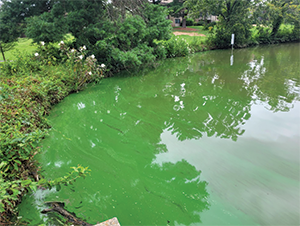
Not all algae blooms are cyanobacteria, and not all cyanobacteria produce toxins. One of the challenges with algae blooms is that they cannot be reliably identified as harmful or harmless by appearance alone. Testing is required to determine whether toxins are present, and results can take time. The safest approach is to assume that any visible bloom could be toxic. When visiting Montgomery Village lakes during the summer and early fall, a few simple precautions can help protect both people and pets:
- Avoid direct contact with the water, especially if algae is visible.
- Keep pets on a leash and prevent them from drinking or entering the water.
- Wash hands thoroughly after any contact with lake water.
While algae blooms are a natural occurrence, awareness and simple precautions can help protect the health of both residents and their pets. Algae blooms are part of a complex and evolving ecosystem, and a reminder of the important connections between our environment, our community and our health.
About the author